
Author: Living in Korea Guide

  • Healthcare in Korea: Find a Provider and Check Your Coverage

    Healthcare in Korea: Find a Provider and Check Your Coverage

    Before a non-emergency medical visit in Korea, check the provider’s services, language support, appointment rules, and how you will pay. Tourists and registered foreign residents may have different insurance arrangements.

    Confirm the provider can help

    Contact the clinic or hospital with the service you need and ask whether an appointment or referral is required. Confirm the branch and department rather than relying on a hospital name alone. If you need English support, ask whether it is available for your actual appointment time.

    Check insurance before assuming a price

    Foreign residents should confirm their own National Health Insurance status with NHIS. Eligibility, enrollment, exclusions, and covered services depend on the applicable rules and individual circumstances. A tourist should check their travel-insurance policy and the provider’s payment process.

    Ask whether you must pay first and claim reimbursement later. Do not assume a quoted consultation fee includes tests, procedures, medicines, or services outside your coverage.

    Bring useful records

    Ask the provider which identification and documents it requires. Prepare a concise list of current medicines, allergies, relevant medical history, and the problem you want assessed. A translation app or a written note can support communication, but important clinical information should be confirmed with the professional.

    Keep the documents you may need later

    Before leaving, clarify the next step, follow-up arrangements, and how to obtain receipts or medical documents for your insurer. Check your insurer’s requirements before requesting a particular form, since a receipt alone may not be sufficient for a claim.

    This is a guide to using services, not a diagnosis or a treatment recommendation. For an urgent or potentially serious problem, use Korea’s emergency care system rather than waiting for an ordinary appointment or an email reply.

    Official resources

    National Health Insurance: Guidance for foreigners

  • Korean Pharmacies: Ask About Over-the-Counter Medicine Safely

    Korean Pharmacies: Ask About Over-the-Counter Medicine Safely

    At a Korean pharmacy, explain what you need to a pharmacist and confirm the instructions for the exact product you receive. A familiar brand name or similar-looking package does not establish that a medicine has the same ingredients or directions as one from home.

    Prepare a clear explanation

    Bring the original package or a clear photo showing the active ingredients of a medicine you already use. Prepare a short description of the problem and any allergies, current medicines, or other relevant circumstances the pharmacist needs to assess the request.

    Check understanding before buying

    A translation app can help you begin the conversation. Ask the pharmacist to confirm whether the product is appropriate, whether a prescription or medical visit is needed, and how to use and store it. Do not guess a dose from a translated product name.

    Keep the actual instructions

    Ask for instructions you can understand and keep them with the original packaging. If anything is unclear, ask again before using the medicine. Check with the pharmacist before combining products, particularly when different brand names may contain overlapping ingredients.

    Find an open pharmacy

    Check the branch’s current opening hours and call ahead when possible. The Korea Tourism Organization’s pharmacy guide links to pharmacy-search services for holidays and late-night needs. A map listing is not a guarantee that a branch is currently open or has a particular medicine in stock.

    If the pharmacist advises a medical assessment, follow that recommendation. This page does not recommend a medicine, dose, or treatment, and a pharmacy search should not delay urgent medical care.

    Official resources

    Korea Tourism Organization: Pharmacy guide

  • Using Foreign Cards at Korean ATMs: Fees, Limits, and Currency Choices

    Using Foreign Cards at Korean ATMs: Fees, Limits, and Currency Choices

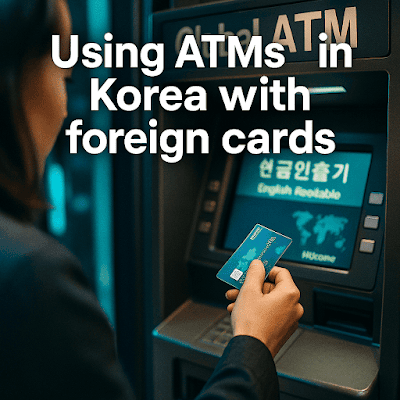
    Before using a foreign card at a Korean ATM, check the card network, your issuer’s overseas cash-access settings, and the fees shown on the machine. Acceptance and withdrawal limits vary, so there is no universal fee or success rate for every card.

    Check with your card issuer

    Confirm that overseas ATM withdrawals are available, that you know the correct PIN, and that the card and account have sufficient available funds. Ask about your issuer’s withdrawal limit and charges. Use the issuer’s official app or support contact; do not share your PIN or security codes with someone offering to help.

    Read the ATM’s offer

    Choose an available language and compare the network marks on the machine with your card. Review the withdrawal amount, operator fee, and any currency-conversion offer before confirming. A machine’s limit can differ from the limit set by your own bank.

    Understand the currency choice

    Some ATMs offer dynamic currency conversion, which presents the withdrawal in your home currency. Visa says the screen should show the amounts, exchange rate, and additional markup, and the choice must be yours. Compare the offer with your issuer’s terms; declining this conversion does not itself prevent an international withdrawal.

    If the transaction fails

    Read and save the error message rather than repeatedly entering the PIN. Check for an issuer notification, and contact the issuer if the reason is unclear. If the card is retained, use the operator contact shown on the machine and tell your issuer promptly.

    After a withdrawal, collect the card, cash, and receipt and check the account entry. For a charge without cash being dispensed, keep the ATM location, time, amount, and transaction reference so the operator and issuer can investigate.

    Official resources

    Visa: Dynamic currency conversion
    Visa: Using your card abroad