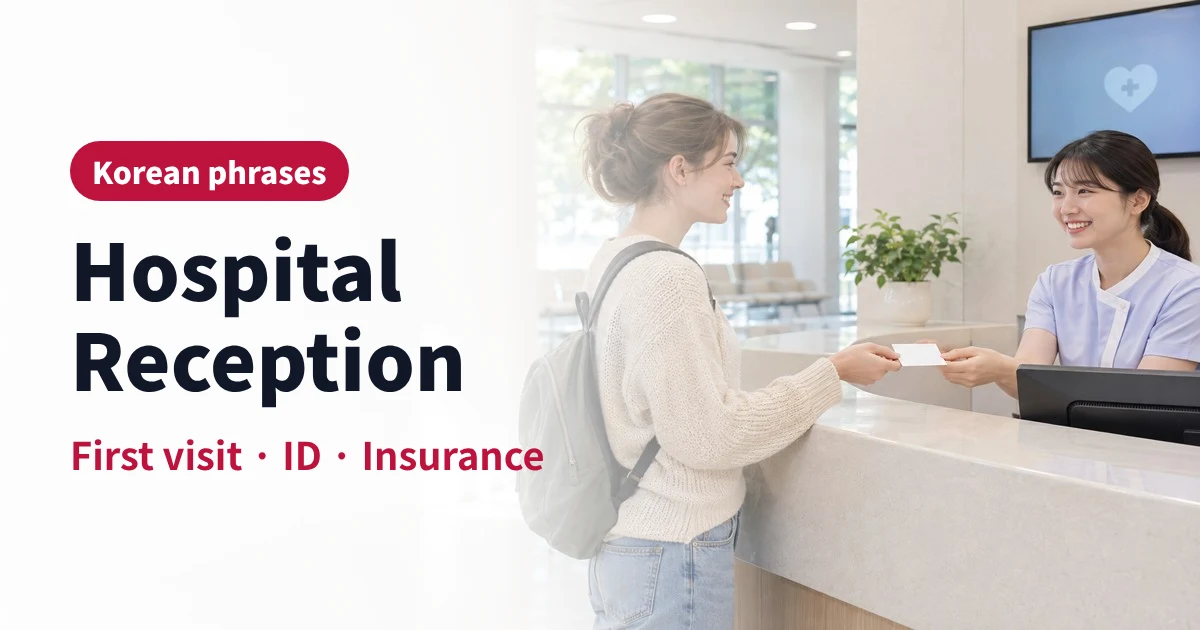
· You live in Korea and are going to a clinic or hospital for the first time
· You want short Korean sentences for the reception desk, with romanization you can actually read
· You are not sure what ID to bring for health insurance
At a Korean hospital or clinic, the first stop is the reception desk (접수, jeopsu). Since May 20, 2024, you must show a valid ID to get National Health Insurance coverage, so have your residence card (or the mobile NHI app) ready before you say anything. The sentences below cover first visit, ID, insurance, department and payment.
The 5 sentences you will use most
① 처음 왔어요. — Cheoeum wasseoyo. — It’s my first visit.
② 접수하려고요. — Jeopsuharyeogoyo. — I’d like to check in.
③ 외국인등록증이에요. — Oegugindeungnokjeung-ieyo. — This is my residence card.
④ 건강보험 있어요. — Geongangboheom isseoyo. — I have national health insurance.
⑤ 영어 하시는 분 있어요? — Yeongeo hasineun bun isseoyo? — Is there anyone who speaks English?
All sentences here use the polite “-yo” form, which fits any reception desk. Romanization follows the National Institute of Korean Language’s Revised Romanization rules, so it matches how the words sound, not how they are spelled letter by letter.
Korea’s Ministry of Health and Welfare made ID checks mandatory for health insurance at hospitals, clinics and pharmacies from May 20, 2024. If you can’t show ID, the desk may not apply your insurance to that visit.
| What to bring | Notes (official guidance) |
|---|---|
| Residence card (외국인등록증 / 거소신고증) | Accepted as ID for expats |
| Mobile NHI app or QR code | Can be used instead of a physical card |
| E-signature / authentication services | Also accepted |
| Exceptions | Minors; ER patients, people with severe disabilities, long-term care recipients and pregnant women can give their registration number |
If you already use the mobile residence card, check that it opens before you leave home. Setup and phone-change steps are in Korea Mobile Residence Card.
Hand over your card, then use one or two of these. You don’t need all of them.
| Korean | Romanization | English |
|---|---|---|
| 처음 왔어요. | Cheoeum wasseoyo. | It’s my first visit. |
| 예약했어요. / 예약 안 했어요. | Yeyakhaesseoyo. / Yeyak an haesseoyo. | I have an appointment. / I don’t. |
| 신분증 여기 있어요. | Sinbunjeung yeogi isseoyo. | Here’s my ID. |
| 건강보험이 없어요. | Geongangboheomi eopseoyo. | I don’t have national health insurance. |
| 어느 과로 가야 해요? | Eoneu gwaro gaya haeyo? | Which department should I go to? |
| 얼마나 기다려야 해요? | Eolmana gidaryeoya haeyo? | How long is the wait? |
| 천천히 말해 주세요. | Cheoncheonhi malhae juseyo. | Please speak slowly. |
This is where most people get stuck: you prepared your own sentence, then the staff asks something back. These are the common ones.
| You hear | Romanization | Meaning → answer |
|---|---|---|
| 성함이 어떻게 되세요? | Seonghami eotteoke doeseyo? | What’s your name? → say your name as on your card |
| 생년월일이요? | Saengnyeonwoririyo? | Date of birth? → year, month, day |
| 신분증 보여 주세요. | Sinbunjeung boyeo juseyo. | Please show your ID. |
| 처음 오셨어요? | Cheoeum osyeosseoyo? | First time here? → 네 (ne, yes) / 아니요 (aniyo, no) |
| 어디가 불편하세요? | Eodiga bulpyeonhaseyo? | What brings you in? → point and say the body part |
| 이거 작성해 주세요. | Igeo jakseonghae juseyo. | Please fill this out. |
| 이름 부르면 들어가세요. | Ireum bureumyeon deureogaseyo. | Go in when your name is called. |
Clinics in Korea are named by department, and the sign usually ends in 과 (gwa). Knowing a few helps you find the right door.
| Korean | Romanization | Department |
|---|---|---|
| 내과 | naegwa | Internal medicine (colds, stomach, general) |
| 이비인후과 | ibiinhugwa | Ear, nose and throat |
| 정형외과 | jeonghyeongoegwa | Orthopedics (bones, joints) |
| 피부과 | pibugwa | Dermatology |
| 치과 | chigwa | Dentist |
| 안과 | angwa | Eye clinic |
Not sure whether to go to a clinic or a big hospital?
Going straight to a large hospital can cost more.
How to find a provider and check your coverage
👉 Healthcare in Korea f… 보러가기After the doctor, you usually go back to the same desk or to the payment counter (수납, sunap). Ask for documents here if you need them for private insurance at home.
| Korean | Romanization | English |
|---|---|---|
| 수납은 어디서 해요? | Sunabeun eodiseo haeyo? | Where do I pay? |
| 처방전 주세요. | Cheobangjeon juseyo. | May I have the prescription? |
| 진료비 영수증 주세요. | Jillyobi yeongsujeung juseyo. | May I have a medical bill receipt? |
| 진료확인서 주세요. | Jillyohwaginseo juseyo. | May I have a certificate of treatment? |
With the prescription, the next stop is a pharmacy (약국, yakguk). Phrases for that step are in Korean Pharmacies.
Q. Can I use my passport as ID?
The government’s guidance names residence cards, e-signatures and the mobile NHI app/QR. If your passport is your only ID, ask the desk first: “여권도 돼요?” (Yeogwondo dwaeyo?, “Is a passport OK?”).
Q. Who can I call about the ID rule?
The National Health Insurance Service (NHIS) handles questions at 1577-1000.
Korea.net (Ministry of Culture, Sports and Tourism), “ID verification system to ensure fairness in health insurance” — mandatory ID from May 20, 2024, accepted forms, exemptions, NHIS 1577-1000
National Institute of Korean Language, Revised Romanization of Korean (korean.go.kr)
Last checked 2026-11-26
How this was made: drafted with AI tools and checked against the official sources above.